A $2,000 Engineer and an Agent Swarm vs. Six Floors of Sour-Faced Mandarins: Why an Autonomous Pipeline Replaces State Oversight—and Where the Paper-Pushers Are Headed in Two Years
Engineering economics of 2026: how three autonomous agent nodes on bare metal replace three hundred chancellery offices in 60 seconds, why the bureaucracy fears transparent efficiency metrics more than the GRU, and why the paper floors face the fiscal knife within 24 months.
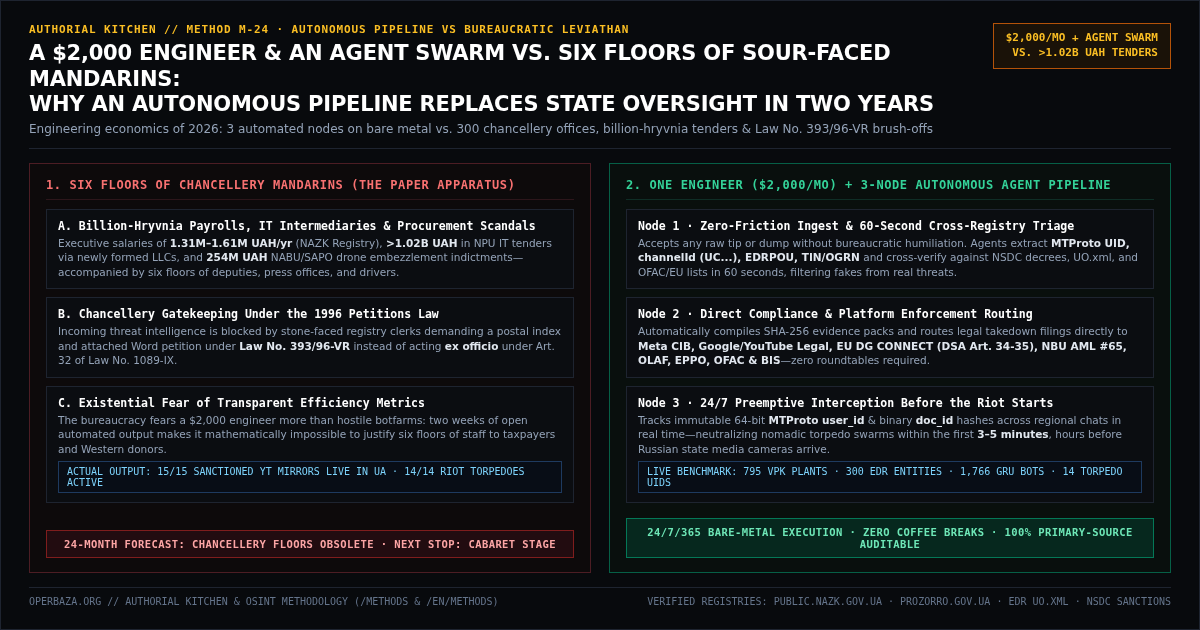
> ENGINEERING CREDO: "We claim no infallibility and cannot physically cover a scope of this magnitude alone—let alone without a single error. Our purpose is to demonstrate open-source cross-registry analysis in action. We genuinely welcome anyone who audits these datasets, flags inaccuracies with primary sources, and builds larger, sharper, and better pipelines using cross-registry synthesis."
1. The Economics of the Absurd ($2,000/mo vs. Billion-Hryvnia Payrolls): One Bare-Metal Server Against Six Floors of Institutional Vanity
Let us run a cold accounting autopsy on November 2026. Strip away the glossy conference lanyards, the five-star hotel roundtables on "strategic synergy," and the commemorative plaques. Look strictly at the ledger, the system architecture, and the primary state registries.
On the left side of the scale sits the traditional state information, digital, and sanctions-oversight apparatus. Six floors of prime real estate in central Kyiv. Miles of red carpet, turnstiles, receptionists, departments of strategic communications, directorates of European integration, document-flow divisions, chauffeurs, advisers, and press offices.
What does this monument to paper cost the Ukrainian taxpayer and Western donors? Let the primary registries speak:
- A single agency head or department chief draws an official annual salary between
1.31 millionand1.61 million UAHin the National Agency on Corruption Prevention (NAZK,public.nazk.gov.ua) declaration registry for2025: Head of the State Service of Special Communications and Information Protection (SSSCIP,EDRPOU 34620942) Major General Oleksandr Potii declared1,612,719 UAH(NAZK UUID d87656b3-c1da-49d2-b2ff-7d6097d2ebcaof2026-03-25); First Deputy Head Rostyslav Zamlynskyi declared1,317,985 UAH(UUID fdb750d5-05b4-439e-a9d7-1f3cf3f3b960of2026-03-24); Chief of the Cyberpolice Department of the National Police of Ukraine (EDRPOU 40116400) Police General Yurii Vykhodets declared1,439,468 UAH(UUID 1126402f-4e3f-4b78-9d23-8dc4084dc3d1of2026-03-30). - Layer on top the public-procurement pipeline in
Prozorro: in2025–2026alone, the centralized procurement arm of the National Police (State Institution "TsOP NPU",EDRPOU 40108981) routed over1.02 billion UAHin IT tenders through a tight circle of newly minted limited-liability intermediaries—including33.91 million UAHfor theThreatQ TDRthreat-orchestration platform (UA-2025-11-17-013428-aviaLLC "OPTIDATA",EDRPOU 39693067, authorized capital1,000 UAH) and48.98 million UAHfor theHYAS Insight / Protectattribution suite (UA-2025-05-28-012192-aviaLLC "DINTEKH",EDRPOU 45431544, incorporated in March2024). - Beside that sits the anti-corruption docket of
NABUandSAPOregardingSSSCIPprocurement: the pre-trial investigation completed on2026-10-20(Part 5 Art. 191 CCU) into the254 million UAHdrone procurement embezzlement scheme (60–90%price markups), the investigation completed on2026-08-28into28.4 million UAHand63 million UAHin software procurement misappropriation, and the ongoing62 million UAHHigh Anti-Corruption Court (HACC) trial of former agency leadership.
Now look at the right side of the scale. Welcome to applied systems engineering in 2026: one competent systems engineer on a $2,000/month salary ($24,000/year—less than the annual upkeep of a single ministry anteroom with an espresso machine and a state sedan) operating a purpose-built swarm of autonomous AI agents on a dedicated Linux server.
This pipeline does not occupy six floors. It has no deputy directors for stakeholder engagement, no press secretary adjusting studio ring lights, and no billion-hryvnia intermediary tenders. It does not take three-hour lunches, does not call in sick, and never demands a home postal code under a 1996 statute. Look at its live production output:
795fingerprinted Russian defense-industrial plants (VPK Tier 1 + Tier 2) mapped down to exact electrical substation and gas-distribution coordinates (GPP / GRP / oxygen stations), Western CNC machine tools on shop floors, and253general directors and chief engineers who slipped through Western sanctions lists;300verified corporate entities and sole proprietors with Russian or NSDC/EU-sanctioned capital operating inside Ukraine's live Unified State Register (UO.xmlandFOP.xmlof2026-10-27) representing over26.7 billion UAHin authorized capital with0%namesake false positives;74active Ukrainian legal entities (EDRPOU) of the ROC / FSB ecclesiastical-intelligence network, cross-anchored against31digitally signed Russian Federal Tax Service (FNS EGRUL) extracts;1,766certified GRU botfarm accounts indexed by numericUID, Latin-Cyrillic homoglyphs, andru-RUsystem locale signatures (hard-sign / yeru suffixes);15active YouTube mirror channels of individuals under Ukrainian NSDC personal sanctions streaming freely into Ukraine (availableCountryCodes: ["UA"]) and14nomadic Telegram riot-torpedo accounts pinned by immutable64-bit MTProto UIDafter the Petropavlivska Borshchahivka provocation.
Weigh the two outputs side by side. Six floors of salaried bureaucracy burning billions produce zero blocked sanctions mirrors (15/15 live) and zero neutralized riot torpedoes (14/14 active)—plus a signed chancellery brush-off. One $2,000 engineer running an autonomous agent swarm on bare metal executes 100% of the actual combat mission of entire state directorates.
2. Three Pipeline Nodes Instead of Three Hundred Offices: How Autonomous Oversight Actually Works
Why does one applied engineer with an agentic pipeline run circles around three hundred office mandarins in 2026? Because a bureaucracy routes a piece of paper up and down a vertical chain of command for thirty days so eight people can initial *"For consideration"* in the margin. An engineering pipeline replaces all three hundred offices with three closed-loop execution nodes.
#### Node 1. Zero-Friction Ingest and 60-Second Cross-Registry Triage (Zero Humiliation, Zero Postal Codes)
To a stone-faced chancellery gatekeeper, an incoming threat report from a citizen is an annoying interruption to his tea schedule. Hand a state agency a verified table of hostile infrastructure and they will slap you with the Law of Ukraine "On Citizens' Appeals" No. 393/96-VR of 1996-10-02, demanding a home street address, a postal index, and an attached .docx petition (verbatim per the SSSCIP Document Management Office refusal Message-ID: <4900a19bcb6a62849dd9a52170cb58a2@cip.gov.ua> of 2026-11-06).
In an autonomous pipeline, Node 1 is engineered on the exact opposite premise:
- Frictionless ingest of any raw signal: the intake gateway accepts raw URLs, forwarded messages, screenshots, CSV dumps, or unstructured tips in any format—zero registration forms, zero bureaucratic humiliation.
- Instant extraction of immutable primary keys: within seconds, first-echelon agents strip away the disposable cosmetic wrapper (display names, avatars, headlines) and extract the immutable cryptographic and registry identifiers that cannot be faked:
64-bit MTProto user_id, binary mediadoc_id, YouTubechannelId(UC...), numeric FacebookUID(615...), 8-digit UkrainianEDRPOU, 10/12-digit RussianFNS TIN/OGRN(validated via modulo checksum math), orASN / RIPEnetblocks. - 60-second cross-registry verification: instead of drafting an inter-agency memo that takes four weeks to cross the street, the agent swarm queries local indexed snapshots of primary state registries in under a minute—Presidential Decrees enforcing NSDC sanctions (Nos.
153/2022,23/2023,230/2025,267/2025,345/2025,417/2025under the Law of Ukraine "On Sanctions" No.1644-VII), live Ministry of JusticeUO.xml / FOP.xmldumps,Prozorrocontract ledgers, RussianEGRULtax filings, andOFAC SDN / EU / UKsanctions lists. - Hard anti-fake triage gate: if an incoming tip is an unsubstantiated rumor, a commercial hit piece without primary registry keys, or a surname collision lacking a secondary identifier match (phone, tax ID, or
UID), Node 1 drops it on the floor automatically. Only100%primary-source-verified threat intelligence advances to Node 2.
#### Node 2. Assembly-Line Compilation and Direct Compliance Routing (Instead of Catering & Roundtables)
What does a traditional ministry do when tasked with "countering hybrid information threats"? It convenes a roundtable, orders shrimp canapes, prints a vinyl banner, and spends four hours discussing "strategic roadmaps for media literacy" while NSDC-sanctioned propaganda channels rack up millions of views in Kyiv and Lviv.
Node 2 does not eat shrimp canapes. The instant Node 1 locks a dual-key registry match, second-echelon agents compile a court-grade Forensic Submission Pack:
- Every entity is mapped to exact domestic and international statutory provisions, bundled with timestamped archival captures (
UTC), machine-readable tables (JSON / CSV), andSHA-256integrity digests. - Under the engineer's supervision, the pipeline routes tailored enforcement filings directly to the compliance desks that actually pull the plug:
- for coordinated inauthentic behavior (
CIB) and sanctioned broadcast mirrors — straight into the compliance portals of global platforms (Meta CIB, Google / YouTube Legal Removals & Threat Analysis Group), the European Commission's DG CONNECT under Articles 34–35 of the Digital Services Act (Regulation (EU) 2022/2065), and the technical blocking contour under Art. 32 of the Law of Ukraine "On Electronic Communications" No.1089-IX; - for financial rails and sleeper Russian corporate assets in Ukraine and the EU — straight to banking AML/CFT compliance desks under NBU Resolution No.
65, OLAF / EPPO (Art. 35 of Regulation (EU)2024/792), DG NEAR, DG FISMA, US OFAC / BIS, German BAFA, Swiss SECO, and UK OFSI / OTSI.
Three months of inter-departmental paper-shuffling collapses into 15 minutes of deterministic code execution.
#### Node 3. 24/7 Preemptive Interception: Catching Disposable Riot Torpedoes in Minute Three—Hours Before Russian TV Cameras Arrive
The fatal flaw of paper bureaucracy is that it operates at the speed of a 1984 post office inside a 2026 cyberwar.
Look at how Russian military intelligence (GRU) executes a kinetic-information provocation in 2026 (exemplified by the Petropavlivska Borshchahivka operation):
- At
21:00, a physical flashpoint or staged confrontation occurs near a sensitive military or municipal site. - Within 10–15 minutes, a nomadic swarm of disposable Telegram accounts floods fifty neighborhood chats and local news-tip bots, posing as "outraged local residents" and inciting crowds to storm the site or torch police vehicles (such as
user_id=8895205236). - Once the seed is planted, the accounts scrub their display names, swap their
@usernames, and migrate to chats in Odesa, Kharkiv, or Dnipro. - Within 2–3 hours, a street crowd materializes, and the footage is syndicated live across
TASS,RIA Novosti, andUkraina.ru.
When a state agency operating on a *"Mon–Fri 09:00–18:00, lunch 13:00–14:00, attach a Word letter"* schedule shows up on Monday morning, the building is already burned down and the Kremlin broadcast has already circled the globe twice.
Node 3 of the autonomous pipeline hunts preemptively 24/7/365:
- It tracks accounts across regional chat graphs not by disposable
@usernames, but by permanent64-bit MTProto user_idintegers (such as the14verified riot torpedoes exported in/feeds/telegram-nomadic-torpedoes.json), binary mediadoc_idfingerprints, and semantic vector embeddings. - The moment two or three known nomadic torpedoes fire synchronized prompts inside a new district chat—within the first 3 to 5 minutes of seeding—Node 3 flags the coordinated wave in real time.
- Automated webhooks push instant
UIDblocklists to community chat-guard bots, while a full topological map of the active operation lands on the desk hours before the provocateurs can assemble a street crowd for Russian state television.
Operational Metric (2026) | Six Floors of Paper Oversight (The Bureaucratic Apparatus) | One $2,000/mo Engineer + Autonomous Agent Swarm (3 Nodes) |
|---|---|---|
| Cost to Taxpayers & Western Donors | Hundreds of millions in payroll + >1.02B UAH in Prozorro IT tenders + 1.31M–1.61M UAH/yr executive salaries (NAZK) | $2,000/mo applied engineer salary + bare-metal Linux server & industrial APIs |
| Threat Signal Intake & Verification (Node 1) | Refused unless submitted as an attached .docx petition with a postal code under Law No. 393/96-VR (1996); up to 30-day response | 60 seconds: automated extraction of UID / UC... / EDRPOU / TIN, cross-check against NSDC decrees & registries, instant fake filtering |
| Legal & Platform Enforcement (Node 2) | Inter-agency roundtables, catering, and memorandums; 15/15 NSDC-sanctioned YouTube mirrors remain live in UA | 15 minutes: automated SHA-256 evidence packs routed directly to Meta CIB, Google Legal, DG CONNECT (DSA), NCU, OLAF & OFAC |
| Preemptive Torpedo Interception (Node 3) | Post-factum days later (or 14/14 Borshchahivka riot torpedoes left completely untouched) | 24/7 within 3–5 minutes of seeding: real-time interception via immutable 64-bit MTProto UID & doc_id hours before street crowds form |
3. The Real Reason for Institutional Sabotage: Why the Apparatus Fears a $2,000 Engineer More Than the GRU
Whenever you show this architecture to outsiders, they ask the same innocent question: *"Wait—if one engineer on $2,000 a month and a three-node agent pipeline can do all of this automatically, why doesn't the ministry hire him tomorrow and solve the problem?"*
Because you are thinking like an engineer trying to solve a security problem. The bureaucracy is an organism trying to preserve its feeding trough.
To a career mandarin, Russian botfarms, NSDC-sanctioned YouTube mirrors, and nomadic Telegram torpedoes are not an existential threat. Quite the opposite: an undefeated, ever-growing "hybrid menace" is the ultimate budget justification. As long as the threat remains vaguely defined and unsolved, the apparatus can endlessly petition Ukrainian taxpayers and Western donor coalitions (Ukraine Facility, Tallinn Mechanism, EU4DigitalUA / DT4UA, EUAM Ukraine, CoE C-PROC, US INL) for bigger budgets, new directorates, fresh deputy posts, foreign study trips, and another 33.91 million or 48.98 million UAH software tender through a one-thousand-hryvnia intermediary LLC.
Now imagine what happens if you let one $2,000/month engineer and an autonomous agent swarm plug into the first floor of that six-story building.
- In Week 1, the engineer indexes the live Ministry of Justice, NSDC,
Prozorro, andFNSregistries and hooks up theMTProto UIDandYouTube Data APImonitors. - By Week 2, an existential catastrophe hits the building. Because the public dashboard will show, in cold mathematical black and white, that one server rack and one human being—without a single paper memo—verified, packaged, and enforced more real national-security targets in fourteen days than all six floors of departments produced in the previous three years combined.
And on Day 15, Ukrainian taxpayers, the Ministry of Finance, and Western auditors in Brussels, Tallinn, and Washington will ask the one question that cannot be answered with a PowerPoint slide:
*"Gentlemen, if one engineer earning $2,000 a month and a swarm of autonomous scripts on a Linux box deliver 100% of your operational output at 0.01% of the cost—why exactly are Ukrainian and European taxpayers funding six floors of deputy directors, press offices, chauffeurs, document-management clerks, and billion-hryvnia tenders?"*
That is why the paper apparatus fights real engineering automation ten times harder than it fights Russian intelligence. Russian psyops only hit the country. A transparent $2,000 engineering pipeline hits their payroll, their perks, and their NAZK cash declarations.
4. The Two-Year Countdown: A Warm Salute to All Six Floors of Sour-Faced Mandarins—and Your Ticket to the Cabaret Stage
Let us close without diplomatic anesthesia or polite euphemisms. This final paragraph is dedicated personally to that unmistakable caste of puffed-up chancellery mandarins, stone-faced registry clerks, and corridor gatekeepers who have haunted state institutions for thirty years.
You know the exact look. You see them gliding down ministry hallways between the third and fifth floors clutching a cardboard folder, wearing that signature Soviet bureaucratic grimace—the classic sour-faced mandarin scowl ("koziacha morda") designed to signal that they alone hold up the sky. They peer down their noses at the citizen, the volunteer, or the systems engineer who brings them verified combat intelligence. They take a perverse, petty thrill in rejecting a machine-readable threat matrix with the words *"Submit an official letter attached to the message"*—convinced that a 1996 filing rule makes them untouchable gods.
Listen closely, masters of the rubber stamp and guardians of the sacred inbox. Here is the weather forecast from the real world of 2026:
- You thought you could hide forever behind the
1996Law "On Citizens' Appeals" and internal chancellery instructions. You missed the moment when the technological tectonic plates shifted underneath your carpet. - You cannot repeal the laws of computer science and wartime economics with a departmental memo. When an autonomous three-node pipeline executes your entire directorate's three-year workload in forty minutes for
$2,000a month, your six floors of paper-pushing cease to be "state governance"—they become a glaring fiscal anomaly waiting for the axe. - Neither Ukrainian taxpayers (who fund your salaries in
200 millisecondsat every checkout terminal) nor Western auditors in Brussels (DG CONNECT,DG NEAR,OLAF), Tallinn (Tallinn Mechanism / ESTDEV), and Luxembourg (EPPO,ECA) are buying the PowerPoint facade anymore. EveryDKIM-signed brush-off you mail out is now archived as a permanent forensic exhibit for international donor audits.
So savor your state-funded espresso while it lasts, puff out your cheeks in the corridor, and adjust your sleeve protectors. The countdown clock is already ticking.
Give it two more years of relentless engineering automation and hard donor efficiency audits—and all six of those paper floors, along with your incoming-mail registries, coordination sectors, and catered roundtables, are going straight under the fiscal knife. In place of three hundred offices, there will be one quiet server rack catching hostile networks in 60 seconds and one engineer who does not know how to pull a sour bureaucratic face.
And as for the six floors of haughty corridor royalty? Pack your potted ficus plants into a cardboard box and start stretching your hamstrings—because in two years, you are headed straight to the cabaret line to kick your legs under the stage lights!