'Western Fatigue' Measured in Factory Shifts: New /en/nato Rubric Tracking Rheinmetall's Unterluess Lines, 40 Bohdana Howitzers/Month, Lockheed Martin's Texas Hub, and EUR 4.1B EU Cash in a Week vs. Russia's 7.345T Ruble Deficit
To counter the Kremlin's favorite information operation — the claim that 'the West is exhausted and halting military aid' — our permanent /en/nato rubric (/en/issue/is-nato-tired-vpk-coalition-2026-10-30) sets aside talk-show commentary in favor of hard multi-year procurement ledgers from the Pentagon, the European Commission, and NATO's Support and Procurement Agency (NSPA). Factory floor investments and treasury wire transfers tell a markedly different story from Russian state television.
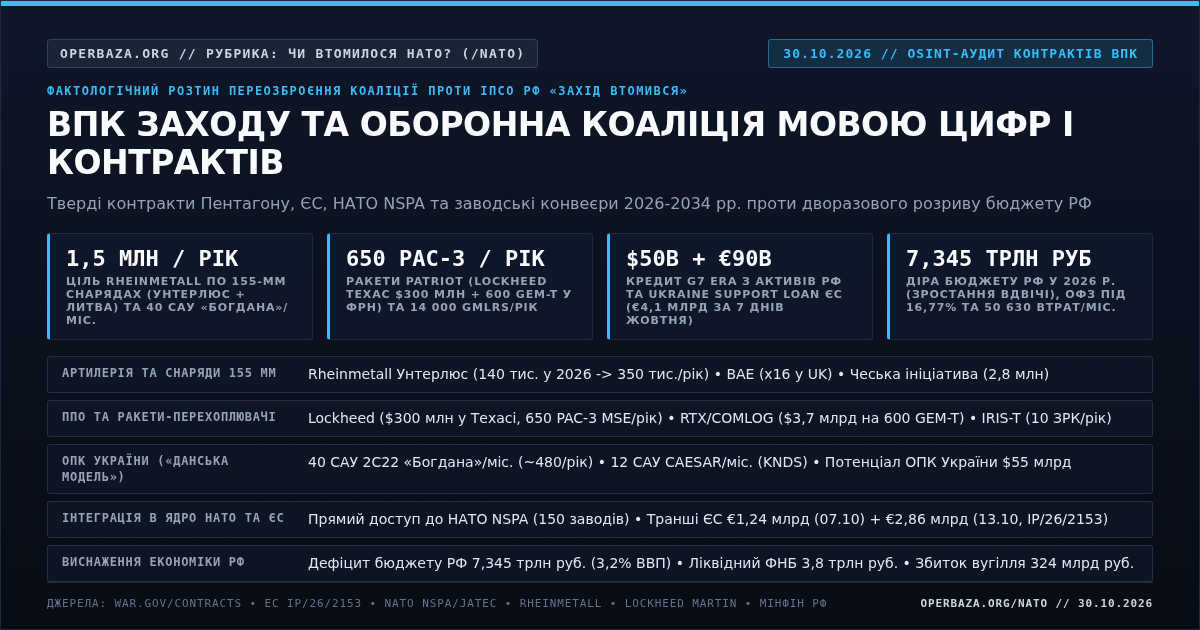
In artillery and ammunition, Rheinmetall's newly commissioned plant in Unterluess, Germany is already shipping 155mm RH1412 shells directly to the Armed Forces of Ukraine, scaling from 140,000 rounds in 2026 to 350,000 per year in 2027, alongside a EUR 300 million ammunition plant under construction in Baisogala, Lithuania. Across the UK, BAE Systems has expanded 155mm shell capacity 16-fold, Franco-German prime KNDS has surged CAESAR self-propelled howitzer output to 12 units per month, and Ukraine's domestic defense industry (now at USD 55 billion in annual production capacity) is rolling out 40 2S22 Bohdana 155mm howitzers every month (~480 per year) financed directly by European allies under the Danish Model.
Air defense and counter-drone missile lines show the same industrial trajectory. Lockheed Martin has invested USD 300 million to expand its Grand Prairie, Texas facility, pushing annual output to 650 Patriot PAC-3 MSE interceptors and 14,000 GMLRS precision rockets per year. In Germany, the RTX/MBDA joint venture COMLOG is executing a USD 3.7 billion contract to manufacture 600 Patriot GEM-T interceptors in Schrobenhausen, BAE Systems holds a seven-year contract producing 25,000 to 35,000 laser-guided APKWS II rockets annually for cost-effective Shahed interception, and Airbus has digitally integrated German IRIS-T SLM fire units with Swedish Patriot batteries under the SAMOC battle management architecture.
On the financial ledger, allied procurement is backed by the USD 50 billion G7 ERA Loans (serviced by immobilized Russian sovereign assets), the EUR 90 billion EU Ukraine Support Loan (under which the European Commission wired EUR 4.1 billion in hard cash in a single October week per release IP/26/2153), and Ukraine's direct access to NATO NSPA procurement frameworks. Meanwhile, Russia's supposedly 'sanction-proof' war economy saw its federal budget deficit double to 7.345 trillion rubles, Russian Railways (RZD) oil freight volumes drop by 12% year-on-year, and 70% of its coal mining sector sink into net losses.